
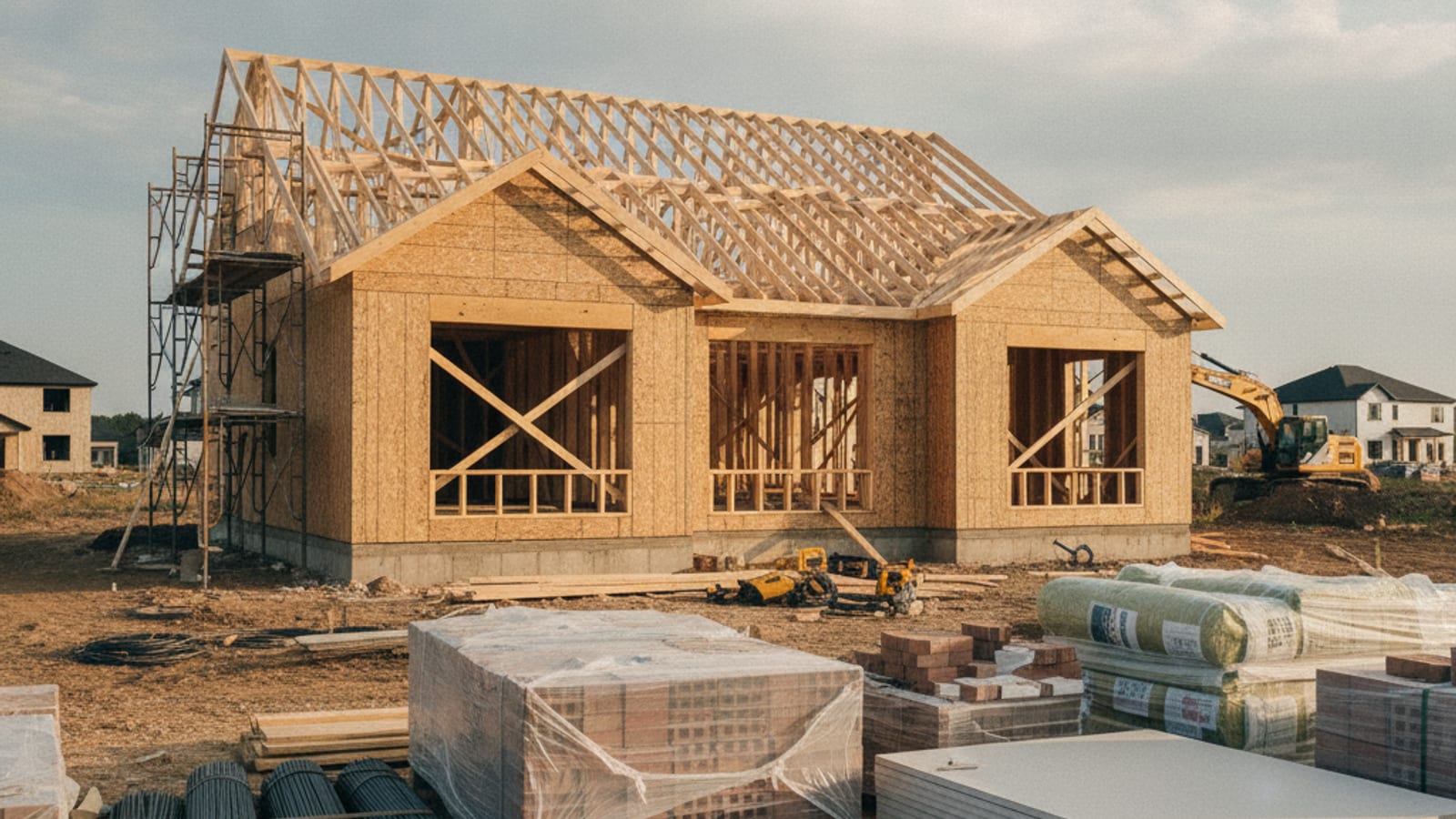
Spring is typically the season when DMV home builders in Maryland, Virginia, and Washington DC push hard to convert buyer interest into signed contracts. But spring 2026 is playing out against a backdrop that demands more than seasonal optimism — it demands a clear-eyed plan. Between escalating tariffs on imported building materials, stubbornly elevated interest rates, and labor market pressures that haven't let up, production builders across the DMV are being squeezed from multiple directions at once. Understanding the forces at work — and acting on that understanding — is what separates builders who protect their margins from those who don't.
The National Picture: Builder Confidence Remains Fragile
The NAHB/Wells Fargo Housing Market Index (HMI) has been a reliable barometer of builder sentiment for more than 40 years, and what it's showing in 2026 is sobering. Builder confidence fell four points to 34 in April 2026 — its lowest reading since September 2025 — driven by economic uncertainty, rising material costs, and persistently high interest rates, according to the National Association of Home Builders. May brought a modest rebound to 37, topping forecasts of 35, but the index remains well below the neutral threshold of 50 and far from the all-time peak of 90 recorded in November 2020.
For context, the historical average of the HMI since 1985 sits at roughly 51 points. The current readings signal that a majority of builders still view market conditions as poor rather than good. That doesn't mean business stops — it means every decision about pricing, spec levels, and lot pipeline carries higher stakes than it did two or three years ago.
How Tariffs Are Hitting DMV Construction Budgets
The tariff environment of 2026 has added a new and unpredictable layer of cost pressure for builders nationwide, and the DMV market is no exception. Materials such as softwood lumber, steel, aluminum, and certain manufactured components are subject to ongoing trade policy changes that make project-level budgeting genuinely difficult. Builders sourcing framing lumber, roofing products, HVAC equipment, windows, and doors are all exposed to price volatility tied to import tariffs.
NAHB has identified trade policy as one of its top advocacy priorities, noting that tariff-related cost increases can add thousands of dollars to the cost of a single home. For production builders in high-cost submarkets like Northern Virginia, Montgomery County, Maryland, and the DC suburbs, those additions come on top of land costs and regulatory fees that are already among the highest in the mid-Atlantic region. The math gets uncomfortable quickly.
What makes tariff exposure especially challenging is its unpredictability. Unlike labor costs or permitting timelines — which are hard to control but relatively stable — tariff rates can shift with little warning. Builders who locked in material quotes six months ago may find those quotes have expired, and replacement pricing reflects a new cost reality.
What Single-Family Construction Data Is Telling Us
Beyond sentiment, the on-the-ground numbers reinforce caution. Single-family construction declined across all geographies in the first quarter of 2026, according to NAHB's Home Building Geography Index (HBGI). The report cites elevated interest rates, rising material costs, and labor shortages as the compounding factors behind the pullback. While the DMV is a resilient market underpinned by federal employment and a highly educated workforce, it is not immune to national construction slowdowns — especially when those slowdowns are driven by cost-side rather than demand-side dynamics.
House price appreciation also slowed markedly in Q1 2026 compared to the pandemic-era boom, according to NAHB's state and metro-level price data. For builders, that shift matters: rising home prices had been providing a buffer that partially absorbed cost increases. As appreciation moderates, that buffer shrinks, and the pressure to manage costs more precisely intensifies.
Strategies for DMV Home Builders in 2026: Protecting Margins This Season
Despite the headwinds, production builders in Maryland, Virginia, and DC have real levers to pull. The builders who will come out of this cycle stronger are those who are operating with discipline and using data to make decisions rather than relying on habits formed in a more forgiving market. Consider the following approaches:
- Lock in material pricing early and strategically. Work with suppliers to secure forward pricing on high-volatility materials — particularly lumber, steel, and manufactured products. Even modest price certainty over a 90-day window can protect a project's margin at contract signing.
- Revisit your spec-level mix. With buyers increasingly rate-sensitive, entry-level and mid-tier spec homes are drawing stronger interest than luxury configurations in many DMV submarkets. Evaluate whether your current spec packages align with where qualified buyers actually are.
- Use concessions strategically, not reflexively. Mortgage rate buydowns, closing cost contributions, and upgrade allowances remain effective tools — but they need to be tied to specific inventory and urgency goals, not deployed as a blanket response to slower traffic.
- Tighten your trade partner pipeline. Labor shortages continue across framing, mechanical, and finishing trades in both Maryland and Virginia. Builders with preferred subcontractor relationships and consistent workflow are facing fewer delays and lower callback costs than those managing a loose vendor network.
- Monitor permitting and entitlement timelines proactively. Jurisdictions across the DMV — including Prince George's County, Loudoun County, and Fairfax County — each have their own pace and policy environment. Delays at the permitting stage are particularly costly when carrying costs on lots have risen alongside interest rates. The Virginia permit surge vs. Maryland slowdown is a dynamic worth watching closely as you plan your lot pipeline.
- Price by community, not by formula. Comp-based pricing that reflects real-time absorption rates in your specific submarket is more defensible than broad market assumptions. Buyers in Bethesda are making different calculations than buyers in Stafford County or Prince William County — your pricing strategy should reflect that.
The Opportunity Inside the Difficulty
It would be a mistake to read the current environment as only negative. When builder confidence is below 40 and starts are declining nationally, weaker or overleveraged competitors tend to pull back. That creates real opportunities for well-capitalized, operationally disciplined production builders in the DMV to gain market share — to pick up desirable infill lots, attract experienced trade partners who are suddenly less busy, and negotiate better terms with suppliers who need volume commitments.
The DMV's long-term demand fundamentals also remain intact. The region's combination of federal government employment, major private-sector employers in defense contracting, technology, and healthcare, and a large share of high-income households creates a floor under demand for new housing that few other metros can match. When interest rates eventually ease — and NAHB's 2026 outlook anticipates incremental improvement — there is meaningful pent-up demand in the pipeline across Maryland, Virginia, and DC that well-positioned builders will be ready to capture. Builders looking to sharpen their go-to-market approach can find tactical guidance in the Home Builder Marketing: The 360° DMV Playbook.
What to Watch Through the Rest of 2026
For DMV builders navigating the back half of the year, three signals are worth tracking closely. First, watch the monthly HMI releases from NAHB — a sustained move back toward or above 50 would signal that the broader industry has absorbed the cost and rate pressures and is finding equilibrium. Second, monitor trade policy developments, particularly any changes to tariff structures on lumber and steel that could shift material pricing in either direction. Third, pay attention to mortgage rate trends: even a 25- to 50-basis-point decline in the 30-year fixed rate has historically produced a measurable uptick in new-home contract activity in interest-sensitive markets like Northern Virginia and suburban Maryland.
The spring 2026 market is not the easiest environment the DMV homebuilding industry has faced, but it is navigable. Builders who stay informed, price carefully, control costs, and maintain strong trade and supplier relationships will be in a strong position — not just to survive this cycle, but to be standing tall when the next upswing arrives. For a closer look at how the local market is moving, see the latest Virginia's New Construction Market: August 2026 Report.