
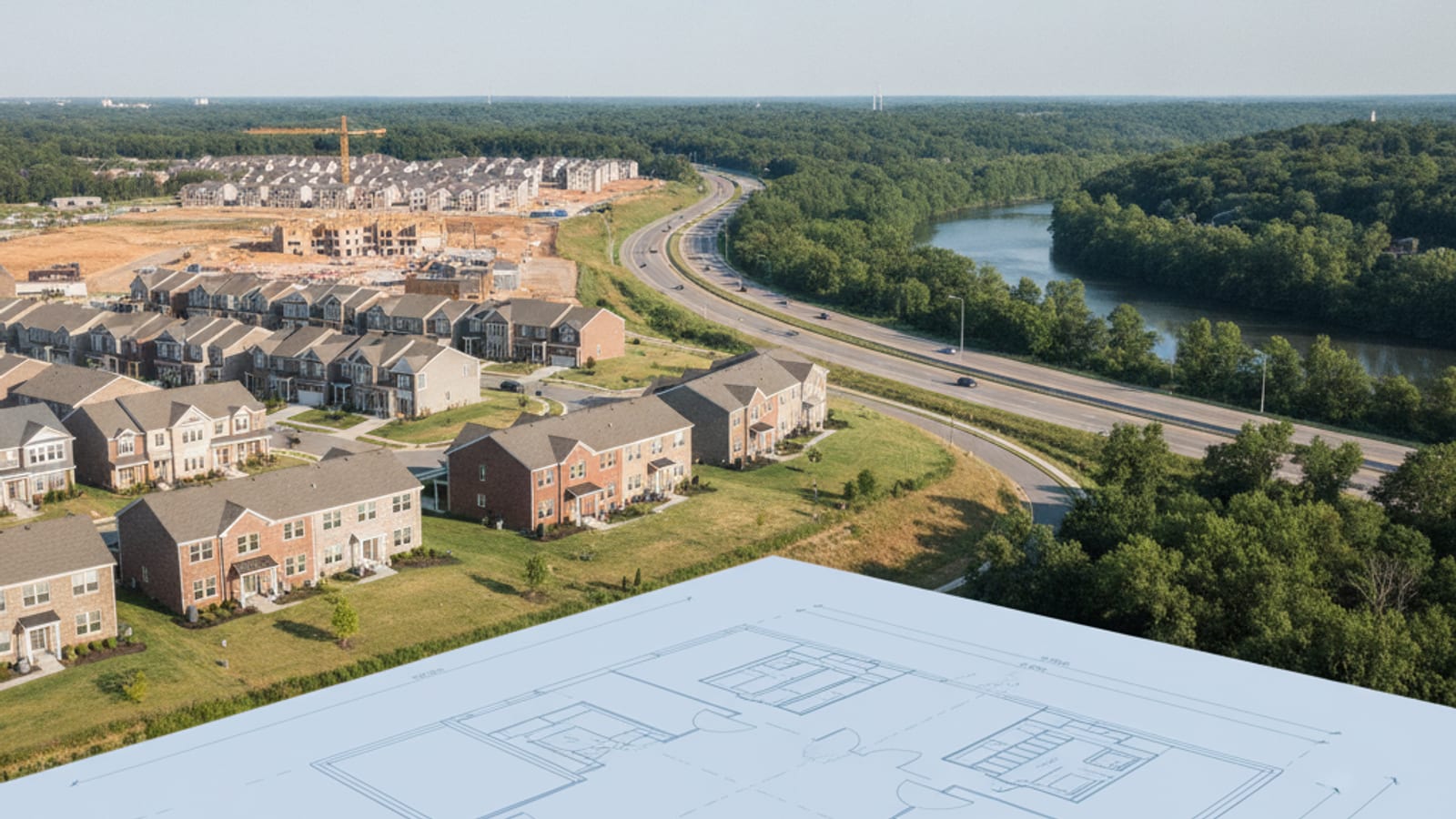
Few regions present a more distinctive opportunity for production home builders than the Washington, D.C. metropolitan area — the DMV, spanning the District, Maryland, and Virginia. Even when national headlines turn cautious, demand here tends to stay resilient, anchored by a deep and diversified employment base. But resilience is not uniformity: the most recent permit and price data reveal a market that is diverging sharply at the state line, rewarding builders who understand the specifics and penalizing those who rely on regional generalizations. Here is a comprehensive look at the forces shaping new construction market trends across Maryland and Virginia right now — and what forward-thinking builders should do about them.
What the Latest DMV Permit Numbers Tell Us About New Construction Market Trends
The headline numbers for mid-2026 are striking. Virginia posted 3,471 monthly private building permits in June 2026, a 33.6% jump year-over-year, according to U.S. Census data tracked via FRED. Maryland, by contrast, recorded 1,028 permits in the same month — essentially flat year-over-year, per the same source. Put those two data points side by side and you have a tale of two markets: a Virginia pipeline that is expanding aggressively and a Maryland pipeline that is contracting even as demand pressures persist.
What explains the gap? Land availability, entitlement timelines, and local zoning reform all play a role. Northern Virginia jurisdictions — particularly in the Loudoun, Prince William, and Stafford corridors — have seen sustained rezoning activity that has unlocked new community sites. Maryland's permitting challenges are more structural: tighter infill land supply in the Baltimore–Washington corridor, slower jurisdictional approvals, and impact-fee environments that raise the effective cost of breaking ground. For a deeper dive into how these diverging permit trends should reshape your pipeline strategy, read our analysis of the Virginia permit surge versus the Maryland slowdown.
On the price side, appreciation has remained positive across both states. Virginia's FHFA house price index reached 768 in January 2026, up 3.8% year-over-year, while Maryland's index stood at 720.1, up 3.4% over the same period, according to FHFA data via FRED. Steady appreciation keeps builder margins from eroding even as construction costs remain elevated — but it also raises the bar on affordability at entry-level price points.
Why New-Construction Demand Stays Structurally Strong in the DMV
Several durable forces underpin new-home demand across Maryland and Virginia, making the region one of the most dependable production-builder markets in the country.
- Federal employment anchor: Government agencies, defense contractors, intelligence community employers, and the vast ecosystem of consulting and professional-services firms that surround them collectively create one of the most stable job markets in the nation. That employment base continuously draws in-migration and household formation.
- Technology sector growth: Northern Virginia is home to the world's largest data-center cluster and a growing roster of tech companies, amplifying demand for both high-end and moderately priced housing across Fairfax, Loudoun, and Prince William counties.
- Resale lock-in effect: With the U.S. average 30-year mortgage rate at 6.69% as of August 2026, per Freddie Mac via FRED, homeowners who locked in rates of 3–4% during 2020–2022 have little financial incentive to sell and trade up. That "lock-in" effect keeps existing inventory tight, funneling more buyers toward new construction as their most practical path to homeownership.
- Household formation demand: Ongoing household formation across the region, fed by that federal and tech job base, represents sustained demand for larger new homes, particularly in suburban and exurban communities.
The result is that even in a high-rate environment, well-located new communities in Virginia's growth corridors and Maryland's close-in suburbs continue to attract buyer interest. The challenge is converting that interest efficiently — a point we return to below.
What Are New-Construction Buyers in Maryland and Virginia Asking For?
Understanding demand is only half the equation. Builders who track evolving buyer preferences convert more efficiently and incur fewer spec-home carrying costs. Across DMV submarkets in 2026, several priorities surface consistently.
- Energy performance: Buyers weigh long-term utility costs against purchase price, making high-efficiency HVAC, enhanced insulation packages, and solar-readiness meaningful value-adds rather than optional line items.
- Flexible floor plans: With hybrid and remote work schedules now common, dedicated home offices, convertible bonus rooms, and self-contained guest suites have moved from wish-list to expected features in mid- and upper-price segments.
- Move-in-ready convenience: Many buyers actively prefer a warrantied, finished new home over the uncertainty of renovating aging DMV resale stock — a preference that sharpens when renovation timelines and costs are unpredictable.
- Smart-home integration: Structured wiring, smart-panel readiness, and connected security are increasingly read as standard expectations in new construction, not premium upgrades.
- Low-maintenance exteriors: Fiber-cement siding, composite trim, and HOA-managed common areas reduce ongoing exterior upkeep.
The Challenges Builders Are Navigating in 2026
Strong structural demand does not make building easy. Land in established DMV corridors is intensely competitive, and the cost of entitlement — impact fees, proffers, and infrastructure requirements — can erode project economics before a shovel is in the ground. Material and labor costs remain elevated relative to pre-pandemic baselines, and the tariff environment has introduced new uncertainty on imported inputs. For a detailed breakdown of how tariffs and material costs are affecting spring and summer 2026 project budgets, see our analysis of tariffs, material costs, and the spring market.
On the financing side, rate sensitivity matters even in a resilient market. The 6.69% rate environment (Freddie Mac, August 2026) compresses purchasing power at every price point, from entry-level to upper-tier homes. Builders who offer rate buy-down programs or work with preferred lenders to structure competitive financing have a measurable advantage at the contract table.
Competitive pressure from existing-home sellers is also shifting. As rates gradually trend toward historical norms, some locked-in homeowners will begin to re-enter the resale market, adding inventory in neighborhoods where new construction currently faces little competition. Builders should model this scenario into their absorption projections for communities with 2027–2028 delivery timelines.
How Builders Can Respond: Strategy, Marketing, and Operations
Market knowledge is only as valuable as the actions it drives. Builders winning in the DMV in 2026 are competing on speed, accuracy, and lead-capture efficiency — not just floor plans and price.
List faster and more accurately. In a market where Virginia's permit pipeline is surging and competition for qualified buyers is intensifying, the time between a certificate of occupancy and a live, accurate MLS listing is a direct cost. Platract's platform runs a 69-point automated check on every new listing — covering 13 required fields, 8 compliance checks including a Fair Housing screen, 17 Bright MLS fields, and 31 best-practice warnings — so builders catch errors before they reach the MLS rather than after. Learn more about the most costly MLS listing mistakes builders make and how to avoid them.
Keep your website and MLS in sync. Price changes, status updates, and spec modifications happen constantly during a community's sales cycle. When your builder website shows a different price or availability than the MLS, buyers lose confidence and agents lose trust. Platract's MLS Watchdog checks for mismatches every six hours, flagging discrepancies automatically so your marketing stays accurate without requiring manual audits. For more on why this matters, see how to keep your builder website and MLS listings in sync automatically.
Capture every lead from the major portals. In a market where resale inventory is tight and buyers are actively searching Zillow, Realtor.com, and similar platforms for new construction options, automatic buyer-lead capture from those portals is not optional — it is table stakes. Builders who let portal inquiries go unrouted or delayed are leaving qualified prospects for competitors to close. Purpose-built new construction listing management software is designed to close exactly that gap.
Invest in 360° marketing. Professional photography, accurate listing data, and multi-channel distribution compound each other. A community that is photographed professionally, listed without errors, and promoted across portals and social channels simultaneously commands more buyer attention than one that is marketed piecemeal. The operational overhead of running all of that manually is a problem that purpose-built new-home sales software is designed to solve.
Looking Ahead: What the Data Points Toward
The structural case for new construction in the DMV remains intact: a stable employment base, persistent resale inventory constraints, and sustained demand for what new homes deliver. Virginia's permit surge signals that builders are already responding to that opportunity, while Maryland's permit decline suggests a market where careful site selection and faster time-to-market will separate profitable communities from stalled ones. Builders who combine granular market intelligence with efficient listing, compliance, and lead-capture operations are best positioned to turn these conditions into consistent closings — regardless of which direction rates move next.