
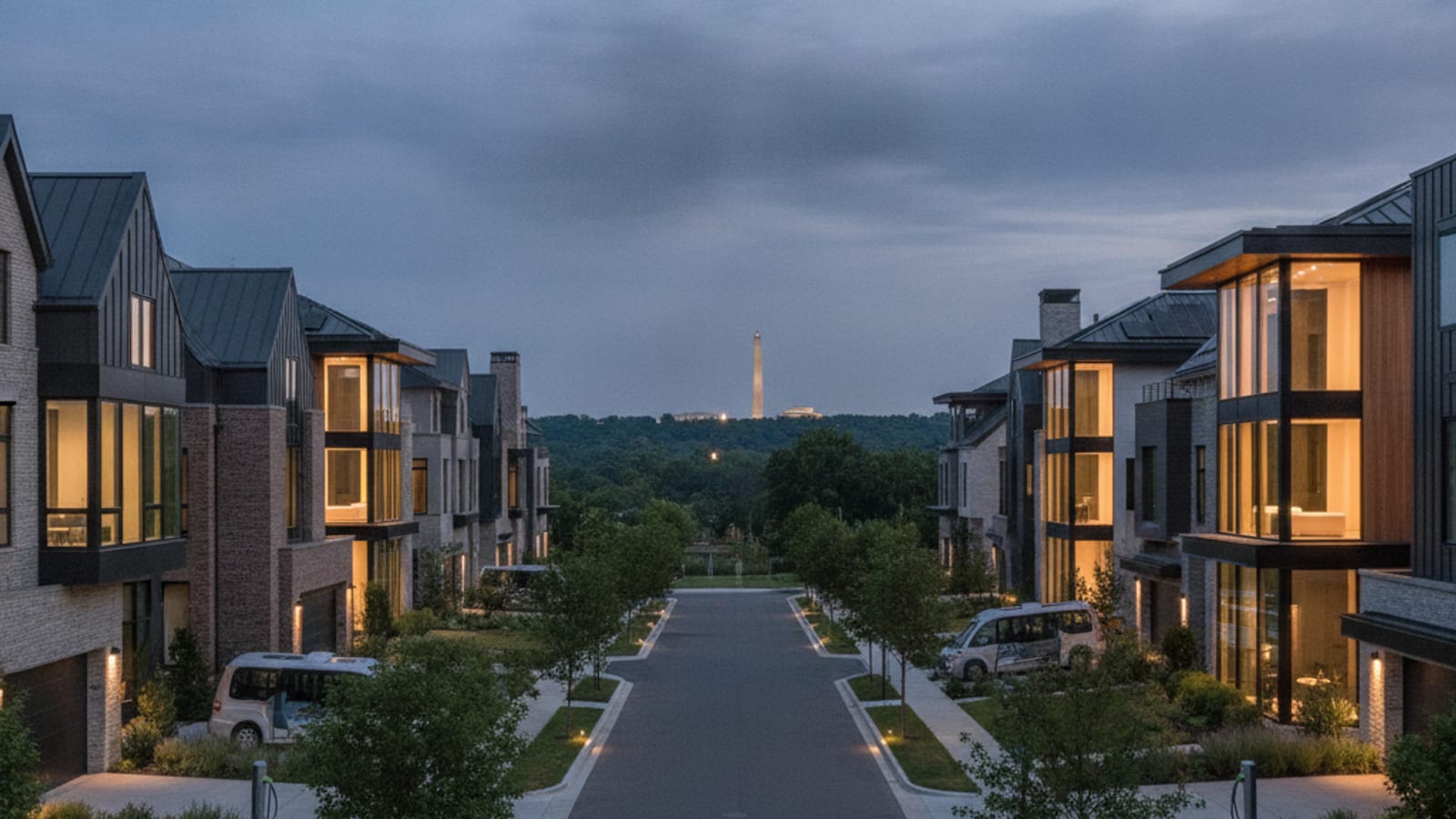
Custom home building trends in the DMV are telling a story worth paying attention to in 2026. While the broader single-family housing market has faced headwinds — NAHB's Eye on Housing reports that overall single-family construction fell nearly 7% for the first seven months of 2026 — custom home building has emerged as a relative bright spot nationally.
Layer that onto surging permit activity right here in the region: Virginia issued 3,228 private building permits in July 2026, a striking 25.3% year-over-year increase, according to U.S. Census data via FRED. Maryland issued 1,039 permits that same month, down 11.4% year-over-year. For production and custom builders operating across Northern Virginia, Maryland, and the broader DC metro, that combination of national resilience and local momentum is an opening — if they move quickly and market smartly.
Why Custom Home Building Trends DMV Builders Are Watching Matter in 2026
Custom home building is holding its ground for a few interconnected reasons. First, buyers who can afford to build custom are, by definition, less rate-sensitive than the median purchaser. With the 30-year mortgage rate sitting at 6.66% as of August 2026 (Freddie Mac via FRED), buyers at the move-up and upper price tiers are still transacting — especially when existing resale inventory in the DMV remains tight. Second, supply constraints that have long characterized Northern Virginia — land costs, zoning friction, and regulatory complexity — actually favor builders who can navigate them. As NAHB's Eye on Housing has noted, "custom home building has been a relative bright spot for the residential construction industry" precisely because these projects are less dependent on spec-cycle financing and bulk land acquisition.
The Northern Virginia Building Industry Association (NVBIA), an 80-plus-year-old trade organization that also connects its members to the Home Builders Association of Virginia (HBAV) and NAHB nationally, has long highlighted how regulatory and land-cost pressures shape the regional building landscape. Builders who are deeply embedded in that advocacy environment — aware of zoning changes, entitlement timelines, and local policy shifts — are better positioned to site new custom projects before competitors even identify the opportunity.
What Do the Local Price Trends Mean for Builders?
Rising home values in the DMV reinforce the case for custom construction. Virginia's FHFA House Price Index reached 780.9 in April 2026, a 3.8% year-over-year gain, per FHFA data via FRED. Maryland's index came in at 722.2 for the same period, up 2.2% year-over-year. These appreciation figures matter to builders in two ways. First, rising prices compress buyer urgency in the resale market — shoppers who feel they've "missed" an affordable existing home become stronger prospects for new construction. Second, higher appraised values mean better margins on completed custom homes, giving builders more room to absorb the material-cost pressures that NAHB has flagged as a growing concern, particularly for smaller firms.
For builders tracking these metrics at the community level, understanding how price appreciation maps to specific submarkets — Loudoun County vs. Prince William vs. Montgomery County — is critical for land decisions. Generic regional averages can mask meaningful local divergence, which is why real estate market analytics for builders focused on the DMV are increasingly a competitive tool rather than a luxury.
See what the MLS is missing — free.
Drop your website and we'll send back which homes the MLS is missing.
We also record the page you sent this from, your country and how you found us.
The Permit Surge: Opportunity and Competition
Virginia's 18.8% permit increase is the kind of number that sounds uniformly positive — but it also signals rising competition. More permits mean more builders pursuing the same lots, the same subcontractors, and the same buyer pool. In that environment, speed-to-market and listing quality become differentiators that directly affect revenue. A custom home that sits on the MLS for 60 days with incomplete fields, outdated pricing, or mismatched specs on the builder's own website is losing money every week.
This is where the operational side of custom building intersects with marketing. Builders who can list a completed or near-complete home quickly — with full MLS compliance, accurate pricing, and professional presentation — capture buyer attention while competitors are still coordinating paperwork. A platform that runs a thorough automated check across required fields, compliance rules (including Fair Housing), and best-practice warnings before a listing goes live can mean the difference between a clean, same-day listing and a costly rework cycle. You can see how that checklist approach applies in practice by reviewing new construction listing management software built specifically for home builders.
Custom vs. Production: Which Model Fits the DMV Right Now?
It's worth being precise about terms, because the strategic implications differ significantly:
- Custom home builders work from buyer-owned lots or source land on behalf of a specific client, with the design largely driven by the buyer. Margin per unit is higher; volume is lower. In the DMV's land-constrained environment, this model avoids the large upfront land-banking risk that can stretch balance sheets.
- Production (spec) builders develop planned communities or individual spec homes, relying on volume and repeatable floor plans to drive profitability. The permit surge in Virginia suggests this model is also expanding, but it demands tighter control of listing pipelines, lead routing, and pricing accuracy across multiple active communities.
- Semi-custom builders occupy the middle ground — base floor plans with buyer-selected finishes. This model is growing in the DC suburbs where buyers want personalization but lots with full design freedom are rare.
Each model has different marketing and operations requirements, but all three share one universal need: the ability to get accurate listings in front of the right buyers fast, and to keep those listings synchronized across every channel where buyers search.
For spec builders in particular, the risk of a price or status mismatch between the MLS and the builder's own website is constant — and it erodes buyer trust when a prospect calls about a home already under contract. Automated monitoring that checks for those discrepancies every few hours is rapidly moving from "nice to have" to table stakes. See how Northern Virginia home builders are navigating the DMV market split for more on how these operational pressures play out locally.
How DMV Builders Should Approach Marketing in This Climate
Given rising permit activity, price appreciation, and the relative resilience of custom construction, Northern Virginia and Maryland builders in 2026 should be thinking about marketing as an integrated system rather than a collection of one-off tactics. A few priorities stand out:
- Lead capture at every portal touchpoint. Buyers searching Zillow, Realtor.com, and similar platforms are already high-intent. Automatic lead capture from those portals — routed into a builder-specific pipeline — ensures no inquiry slips through while the sales team focuses on closings.
- Professional photography and 360° presentation. In a competitive permit environment, visual quality is a direct proxy for perceived build quality. Buyers comparing three similar custom builders on price often make the shortlist decision based on how finished homes are presented online.
- MLS accuracy and compliance, maintained actively. An MLS listing that goes stale — wrong price, closed status not updated, missing required fields — damages both compliance standing and buyer confidence. The builders winning in the DMV right now treat listing accuracy as an ongoing operational discipline, not a one-time upload task. For a deeper look at how automated field protection reduces this risk, see automated MLS field protection for home builders.
- Data-driven community positioning. Understanding where in the DMV price appreciation is outpacing the regional average — and where permit density suggests incoming competition — allows builders to price confidently and choose the right communities to pursue next. The 360° DMV builder marketing playbook covers how to tie these data signals into a cohesive go-to-market approach.
Turning Permit Momentum Into Closed Sales
The Virginia and Maryland permit numbers for July 2026 are genuinely encouraging. But a permit is the beginning of the builder's work, not the end. Converting that activity into closed sales — especially in a market where buyers are rate-aware and have more new-construction options than a year ago — requires tight execution from listing day through closing day.
Builders who manage that process with purpose-built tools, rather than retrofitting general CRM or construction-management software, have a structural advantage. If you're evaluating how your current stack handles listing management, lead routing, and MLS compliance for your DMV communities, a Platract demo shows exactly how the platform handles those workflows — from the 69-point listing check to buyer-lead capture from the major portals — without requiring a long implementation cycle.
The DMV's custom home building opportunity in 2026 is real. The builders who capture it will be the ones who combine local market knowledge with operational speed and marketing precision.